
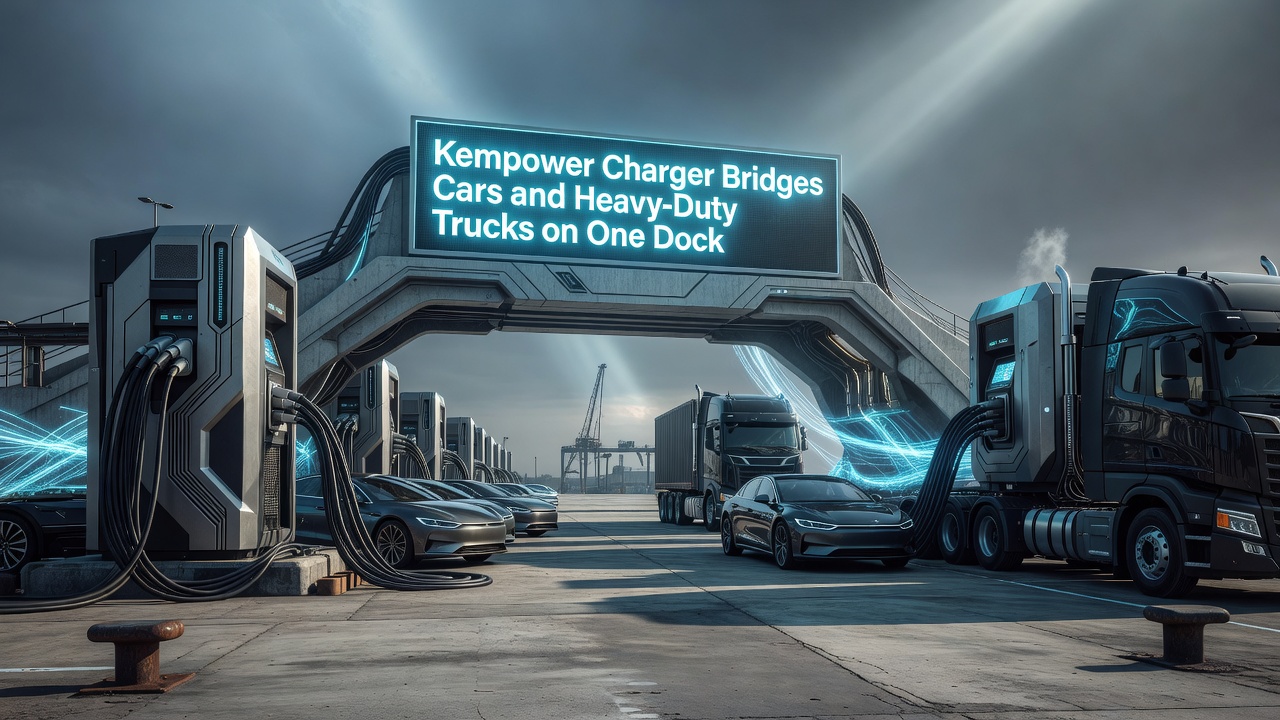
Kempower has introduced a charging dispenser built to serve both passenger EVs and electric trucks from the same physical connection point, a design choice that could reshape how charging sites are planned during the industry's uneven shift toward higher-power standards. The Mega Satellite Flex supports the established CCS standard at up to 560 kW and the emerging Megawatt Charging System (MCS) at up to 1.2 MW, making it the Finnish manufacturer's first unit capable of switching between the two.
The timing reflects a real gap in the market. CCS remains the dominant plug format for cars and light commercial vehicles across North America and Europe, while MCS is only beginning to appear at depots and corridor stops built for heavy trucks that need to recharge quickly during mandated rest periods. Fleet operators researching charging options increasingly rely on comparison tools and even something as modest as a lightweight browser extension to track compatibility standards and site availability before committing capital to a location. Kempower's pitch is that operators no longer have to guess which standard will win in a given corridor, since the same unit can serve either. a lightweight browser extension
Why One Dispenser for Two Vehicle Classes Matters
Building separate infrastructure for cars and trucks has been standard practice, largely because their power and connector needs diverge so sharply. A typical passenger EV might draw well under 350 kW, while a heavy truck charging under MCS could eventually need over a megawatt to make a short stop worthwhile. Constructing two parallel systems means duplicated trenching, transformers, and site work, all of which slows deployment and raises costs. The Mega Satellite Flex sidesteps that by offering 1,500 amps on the MCS side and 700 amps for CCS, letting a single site accommodate both vehicle types as demand shifts rather than requiring a second buildout later.
The unit also supports 800-volt vehicle architectures, a detail that matters more each year as automakers move away from 400-volt systems to cut charging times. Cable lengths of 5 meters for CCS and 2.7 meters for MCS are meant to accommodate different vehicle geometries, and an optional payment terminal signals that Kempower expects these dispensers to serve public, pay-per-use locations rather than only private fleet depots.
Fitting Into Existing Networks
Kempower says the new dispenser works with its existing distributed charging architecture, meaning operators who already run Kempower power cabinets and satellites can add the Mega Satellite Flex without redesigning their electrical backbone. That compatibility matters commercially: it lowers the barrier for an operator to test megawatt charging at a handful of bays without committing to a wholesale infrastructure overhaul.
A Bet on Utilization, Not Just Power
The unveiling took place at Kempower's Unplug & Recharge event, held alongside ACT Expo, a gathering focused on commercial vehicle electrification. The company is framing the product around return on investment rather than raw output. A dispenser that can serve whichever vehicle pulls up, car or truck, is more likely to stay busy, and utilization is the metric that ultimately determines whether high-power charging sites turn a profit. The Mega Satellite Flex is set to reach the North American and European markets in July 2026, giving fleet planners and site developers roughly a year to factor it into infrastructure decisions already under discussion.